Remembering the Santa Cruz Massacre

12 November 2011

To mark the 20th anniversary of the infamous Santa Cruz Massacre, we present here a guide to recent commentary and some archival resources on this landmark event.

Relatives hold photos of Santa Cruz massacre victims during a commemoration in Dili, 12 November 2009. (1)

The shooting by Indonesian troops of an unknown number of unarmed Timorese demonstrators at the Santa Cruz cemetery in Dili on 12 November 1991 was a watershed event in East Timor’s modern history.

While other massacres and much larger losses of life occurred in earlier years of Indonesian rule, the Santa Cruz Massacre became the iconic representation of the military occupation of East Timor.

The essential difference between this event and earlier crimes was that it was witnessed and recorded by independent (ie non-Timorese and non-Indonesian) reporters and other observers.

The impact of this event on East Timor’s future was decisive. In the words of former Indonesian foreign Minister Alatas, thereafter “international support for Indonesia’s position inexorably declined while that for the independence movement in East Timor markedly increased”. (2)

Long-term preservation of the documentary source materials is crucial to retaining for future generations a detailed knowledge and understanding of this event. Some of these documents may also serve justice if the perpetrators of the crimes on this day in 1991 ever face a proper and fair trial.

——————–

Centro Audiovisual Max Stahl – Timor-Leste (CAMS-TL)
British film maker Max Stahl’s dramatic video footage of the massacre was crucial to international knowledge of the event. Copies of the original footage and productions including key scenes are held at CAMS-TL in Dili.

The French National Audiovisual Institute (INA) houses copies of some Max Stahl Timor footage. INA provides sample sequences for viewing online – including the original Santa Cruz footage and subsequent interviews with survivors.

Some Stahl footage can be found on YouTube, including this low resolution sequence.

CHART recently published a guide to CAMS-TL video footage, including the 1991 material and a transcript of some massacre footage.

Resistance Archive & Museum (AMRT)
AMRT provides online access to vast numbers of digitised documents, including Santa Cruz material.

The 20th anniversary is commemorated by AMRT with a special website presentation which also includes a link to a catalogue search result on the term “Santa Cruz”.

Commission for Reception, Truth & Reconciliation (CAVR)
The library and archives of Timor’s CAVR (now managed by a Post-CAVR Secretariat) hold original records on Santa Cruz, including eye-witness accounts. An account of the event and a guide to sources can be found in CAVR’s monumental 2005 report Chega!. See especially Chapter 3 (p.115ff) and Chapter 7 (p.199ff).

ACFOA Human Rights Office
The Human Rights office of the Australian Council for Overseas Aid (now ACFID), headed by Pat Walsh, collected extensive materials on Santa Cruz during the course of its long-standing advocacy work for East Timorese justice and self-determination. CHART produces here for the first time a guide to the content of these files.

This collection of material remains in private hands but under CHART custody where it will be the focus of an extensive digitisation program in 2012 for easy access in Timor-Leste and elsewhere.

East Timor and Indonesia Action Network (ETAN)
ETAN began in the USA in response to the Santa Cruz massacre and soon became a key reference point for international East Timor activism and advocacy.

ETAN marked the 20th anniversary with a feature page on the event and maintains a guide to Santa Cruz information and ongoing calls for justice on the matter.

Clinton Fernandes
Prominent Timor researcher and justice advocate Clinton Fernandes’ web-based Companion to East Timor includes some sample documents and a summary of Santa Cruz.

Jill Jolliffe
Microfiche copies of some Santa Cruz material may be found in Jill Jolliffe’s archival collection. See pages 35-36 of the guide to her collection – The East Timor Question, 1975-1996.

The Jolliffe collection is held by a number of academic and major libraries in Australia and elsewhere.

National Archives of Australia (NAA)
NAA holds large volumes of material on East Timor. However access to its holdings are generally covered by a standard ‘closed period‘ of twenty to thirty years after the events documented. Santa Cruz files will not be open for access until 2016-17.

Indonesia?
With the exception of documentary fragments held in collections outside Indonesia, we have no knowledge of accessible official or unofficial Santa Cruz records in Indonesia.

Other sources and commentary?
Here is a list of other instances,  from disparate sources, of online Santa Cruz materials and commemorations of the 20th anniversary. More to be listed in coming days.

Forensic studies report (2010) by Soren Blau & Luis Fondbrider

Amnesty International Statement (2011-11-12)

Historical Justice & Memory Research Network

La’o Hamutuk reflection (2011-11-12)

VivaNews.com (Indonesian)

TSF Radio Noticias (Portugal) – includes some great still images of Santa Cruz events.

Sapo Noticias Timor-Leste  (Portuguese language feature)

CAN YOU HELP?
If you know of other significant archival collections with Santa Cruz content, please advise us and we will add them to this guide.

Sources:

(1) Martine Perret / UNMIT, 2008. See online source.

(2) Ali Alatas. The pebble in the shoe: the diplomatic struggle for East Timor. Aksara Karunia, Jakarta, 2006, p.64.


SBY’s Timor History

12 March 2010

SBY - top graduate 1973

Indonesian President Susilo Bambang Yudhoyono (SBY), like many of his generation of former military men, has a Timor history. Australian researcher Ernie Chamberlain shows that, while SBY may not have been in the very first wave of the 7 December 1975 Indonesian military invasion, he was on active duty in Timor in those early years of the occupation which had such catastrophic consequences for the Timorese population and resistance. While the detailed story of SBY’s roles inside Timor is yet to be told, what follows sketches the beginning of his Timor history.

Chamberlain writes:

In his senior year (1973) at the Akabri military academy at Magelang, Bambang Yudhoyono was the Dandivkortar (“top cadet”) – overseeing 3,000 cadets. On graduation in November 1973, as the “top student” among the 987 graduates (Prabowo Subianto, by the way, graduated the following year in third place), he was presented with the Bintang Adhi Makayasa medal personally by then President Soeharto.
From Akabri, he was posted as a platoon commander to Kostrad’s 330 Airborne/Raider Battalion (Commander 3 Platoon, “A” Company) serving in the period “1974-76”. That unit’s history website notes that the battalion saw service in Timor in “1975-1976″.
Indonesian journalist and author Hendro Subroto has written on 330 Battalion’s operations in several of his works. In particular, two battalions of 330 Battalion’s formation – the 17th Airborne Brigade/”Satgas B” – parachuted onto the Baucau airfield on 10 December 1975, but 330 Battalion (commanded by Major Syukur) did not arrive in Baucau from Kupang until 14 December in an airlanded operation utilising civil-type aircraft. Soon after landing, 330 Battalion led the ABRI advance south to Viqueque – meeting quite stiff Falintil opposition led by Sabika in the Lariguto/Ossu area.

SBY’s Timor entrance
But was Yudhoyono with 330 Battalion in Timor in December 1975 ? I think not.
Firstly, Hendro Subroto is an inveterate “name dropper”. In relating operations in Timor, he invariably highlights the presence/role of any later-to-become-senior ABRI officers. He makes no mention of Susilo Bambang Yudhoyono in the Baucau/Viqueque operation of 330 Battalion. Moreover, Yudhoyono reportedly attended English language training at the US military’s Defence Language Institute in Texas in late 1975/early 1976, followed by Airborne and Ranger training at Fort Benning in 1975-1976.
He apparently returned to Indonesia in mid-1976 – deploying to Timor in August 1976 as a platoon commander in 305 Battalion (a month after his marriage to the daughter of Major General Sarwo Edhie Wibowo a renowned/infamous commander of the RPKAD and graduate of the Australian Army’s Staff College at Queenscliff, Victoria). While little is known about 305 Battalion’s activities in Timor in 1976-1977, it reportedly operated principally in Lautem.
Among his medals, Yudhoyono wears the Satya Lencana Seroja, 1976 (Operasi Seroja – Operation Lotus – was the name given to the major Indonesian military campaign in Timor from December 1975 to November 1979)

Other connections
As an aside, over the years, Bambang Yudhoyono has had several koneksi with the Australian military – and was a close friend of Lieutenant General Peter Leahy (former Chief of Army, and now a professor heading the University of Canberra’s National Security Institute). They were in the same class at the US Command and Staff College, Leavenworth in 1990-1991 (Leahy was the “top” foreign student, Bambang Yudhoyono was “No.2”). It was planned that Yudhoyono attend the year-long “one-star” ADF ACDSS course at Weston Creek (Canberra) in 1996 – but in November 1995, Yudhoyono was quite suddenly posted to Bosnia-Herzegovina as the Chief Military Observer of the UN Peacekeeping Force.

Sources:

Subroto, S., Operasi Udara di Timor Timor (Air Operations in East Timor), Pustaka Sinar Harapan, Jakarta, 2005, pp.107-197.

Wikipedia: http://en.wikipedia.org/wiki/Susilo_Bambang_Yudhoyono

Military Academy website: http://www.akmil.ac.id

Battallion 330 website: http://www.yoniflinud330.mil.id/

More SBY biographical details: http://www.tokohindonesia.com/ensiklopedi/s/susilo-b-yudhoyono/biografi/keluarga.shtml

Ernie Chamberlain is a retired Australian brigadier, having served for 36 years – including as Australian Defence Attache in Jakarta in the mid-1990s. Since retirement in 1998, he has spent some years in Timor – including advising Defence Minister Roque Rodrigues and F-FDTL commander Taur Matan Ruak on defence policy and planning (2004-05).


The Two Purwantos

31 January 2010

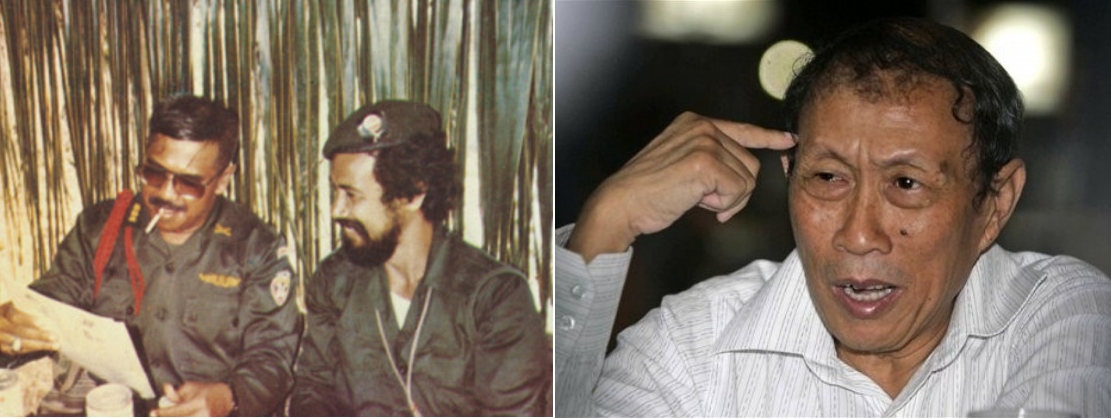
Colonel Purwanto and Xanana 1983               Gatot Purwanto, Jakarta 2009

The name Purwanto is well known in the history of Indonesia’s military occupation of East Timor. In 1983, Colonel Purwanto, then direct commander of Indonesian forces in the territory, represented Indonesia in negotiations with Xanana Gusmao, the commander of the East Timorese resistance army, Falintil.

When a retired Colonel Gatot Purwanto made international news in late 2009 admitting he was a member of the Indonesian military team responsible for killing the ‘Balibo Five’ journalists in October 1975, most assumed this was the same Colonel Purwanto of 1983 negotiations fame.

Australian researcher Ernie Chamberlain believes there are two different Purwantos – though, confusingly, both were involved in different roles in the 1983 negotiations. He writes:

‘In recent weeks, in writing about Timor, a number of contributors have confused two ABRI officers ie Colonel Purwanto (Artillery) – the East Timor commander in 1983 (ie Danrem 164/Wira Dharma) and Major Stefanus Gatot Purwanto – a senior Kopassus detachment commander in Timor in the early 1980s.

‘Major (Kopassus) Gatot Purwanto did the “leg work” in late 1982 and early 1983 in preparing the March 1983 ABRI-Falintil ceasefire talks at Lariguto – while Colonel Purwanto (Danrem 164) was the Indonesian military’s principal in the discussions with Xanana Gusmao.

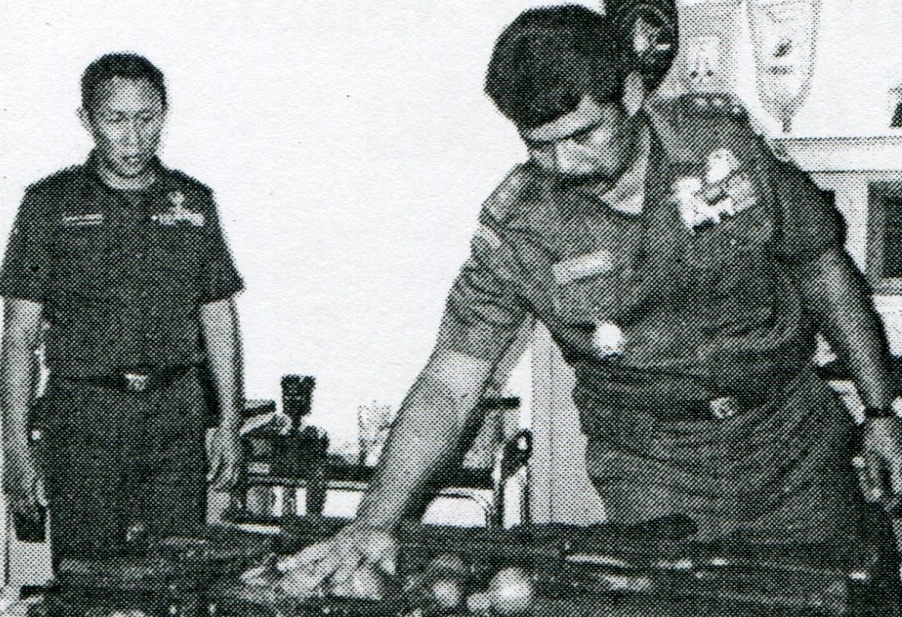
‘Colonel Purwanto (Danrem 164, Artillery) – somewhat “tubby” and “moustachio-ed”, is seen in the 1983 “Lariguto photographs” with Xanana Gusmao. Major Stefanus Gatot Purwanto – as a Colonel, became the ASINTEL Kolakops/Komandan Satgas Intel in Timor Timur in 1990 – and was dismissed/pensioned from ABRI following the 1991 Santa Cruz massacre.

Major General Sintong Panjaitan (right) in Dili after the Santa Cruz massacre, November 1991. Figure at left almost certainly Colonel Gatot Purwanto as a senior intelligence officer

‘Interestingly, in December 2009 during his interviews related to the film “Balibo”, retired Colonel Gatot Purwanto – aged 62, claimed that at the time of the “Balibo incident” in mid-October 1975, he had only been out of AMN Magelang – the ABRI officer academy – for three years:  “I was a first lieutenant at the time, just three years out of officer training school”, he recalled.  However, according to other reports, Gatot Purwanto graduated from AMN Magelang in 1968 (the same year as Wiranto – born in 1947). Also, in Hendro Subroto’s 2009 book on the career of Major General Sintong Panjaitan, a Captain Gatot Subroto is noted as a Kopassandha intelligence officer on operations in West Kalimantan in 1973. The foregoing suggests that perhaps Colonel (Retired) Gatot Purwanto’s December 2009 statement on his seeming ‘junior status’ at Balibo in 1975 requires some further examination.’

Chamberlain Notes on Indonesian military terms:

Danrem is the Komandan Korem ie the Commander of the Military Regency/Sub-Area Command (ie Timor Timor was Korem 164 – established March 1979). “Dan” is for “Komandan” and “Rem” is for “Resort Militer“.

ASINTEL is “Assistant for Intelligence” ie a staff officer on a headquarters responsible for the intelligence function.

Kolakops is “Komando Pelaksanakan Operasi” – ie “Executive Operational Command” – ie a special operational command set up in East Timor (commanded by a brigadier) to manage tactical field operations with the Danrem 164 (a full colonel appointment) being responsible for administration and territorial operations. Kolakops was founded in Timor in 1989 and functioned until 1993 – ie disbanded following the investigation into Santa Cruz. However the operational command appears to have continued covertly from outside Timor ie with “guidance” from Kopassus Group 3 Headquarters in Batujajar, West  Java. Of course, many of the Danrem Colonels in East Timor were Kopassus officers.

Komandan is Commander; Satgas is Satuan Tugas – ie Task Unit – so Satgas Intel – is the intelligence task unit – staffed almost exclusive in East Timor by Kopassus.

Kopassus is Komando Pasukan Khusus –  Special Forces . Originally known as RPKAD – Resimen Para Komando Angkatan Darat, then changed to Kopassandha (Komando Pasukan Sandi Yudha) on 17 February 1971, before becoming Kopassus on 26 December 1986. Therefore, technically, young Lieutenant Gatot Purwanto was a member of  Kopassandha at Balibo in 1975, and also later as Major Gatot Purwanto in Kopassandha when engaged in the 1983 ceasefire machinations.

——–

Ernie Chamberlain is a retired Australian brigadier, having served for 36 years – including as Australian Defence Attache in Jakarta in the mid-1990s. Since retirement in 1998, he has spent some years in Timor – including advising Defence Minister Roque Rodrigues and F-FDTL commander Taur Matan Ruak on defence policy and planning (2004-05).

He has written several privately-published monographs including:
The Struggle in Iliomar: Resistance in rural East Timor (2003, 2004, 2008).
Faltering Steps – Independence Movements in East Timor in the 1950s and 1960s (2005).
Rebellion, Defeat and Exile: The 1959 Uprising in East Timor (2007).
Faltering Steps: Independence Movements in East Timor – 1940s to the early 1970s (2007, 2008).
He has recently completed a monograph on the Timorese who served with SRD/Z Special Unit against the Japanese in Portuguese Timor during WWII.