Tapol & Timor Link now online

6 April 2015

tapol-tlink

Two influential print journals which extensively covered occupation and resistance in East Timor are now available online.

They are Tapol Bulletin, published by the UK-based Tapol and  Timor Link, published by London’s Catholic Institute for International Relations (CIIR, now Progressio).

In cooperation with the publishers, the journals were digitised by the Library of Victoria University in Melbourne and are accessible online through the library’s digital research repository. The digitisation project was initiated by CHART.

TAPOL Bulletin
All issues of the printed journal (1973-2008) can be seen here: Tapol – VU Research Repository.

Created by Carmel Budiarjo in 1973 to campaign for the release of political prisoners held since the 1960s by the Suharto regime, Tapol gave increasing attention to the Timor issue from the mid-1970s.

A particular strength of Tapol’s work on Timor was its knowledge of Indonesian language and politics and it played a key role in making internal Indonesian military documents available internationally.

Timor Link
Most of the issues of Timor Link can be seen here: Timor Link – VU Research Repository.

The London-based Catholic Institute for International Relations was a non-government human rights and development  organisation with interests in central America, southern Africa and Asia. CIIR’s pamphlet series, ‘Comment’ tackled the Timor issue in 1982, marking the start of the organisation’s increasingly influential voice on the topic, especially in European human rights and Christian Church circles.

Timor Link became CIIR’s principle vehicle for news and advocacy on Timor from its inception in 1985 until it ceased publication in 2002.

CHART will add links for these journals to its online access point for digitised Timor newsletters – CHART Periodicals.

Acknowledgements
Chart wishes to thank staff of the Victoria University Library for taking on this digitisation project – especially  Ralph Kiel, Adrian Gallagher, Mark Armstrong-Roper, Lyn Wade and Ingrid Unger.

We also wish to thank Tapol and Progressio staff for their most agreeable response to the project idea – especially Paul Barber and Barbara Patilla (Tapol) and Daniel Hale (Progressio).

—————————————————————–

Note on Tapol/CIIR archives
The materials collected and created by Tapol and CIIR during their years of public advocacy on Timor will be of much interest to future researchers.

Tapol archives: Most of the Tapol archive is held by the Mario Soares Foundation (FMS) in Lisbon as part of a larger collection of its Timorese Resistance archive. Some 6,500 items from the Tapol archive can be seen in digital form on the FMS-created database, Casa Comum.

CIIR / Timor Link: CIIR’s extensive collection of Timor materials has been preserved but is not yet available for research access. CHART briefly examined the collection in London in late 2013; further information to come.


Timor-Leste archives: Development continues

28 March 2015

CHART archivist and manager John Waddingham has just completed his fourth visit to Timor Leste to learn about archival institutional developments there. He reports continuing progress in most of the emerging archives.
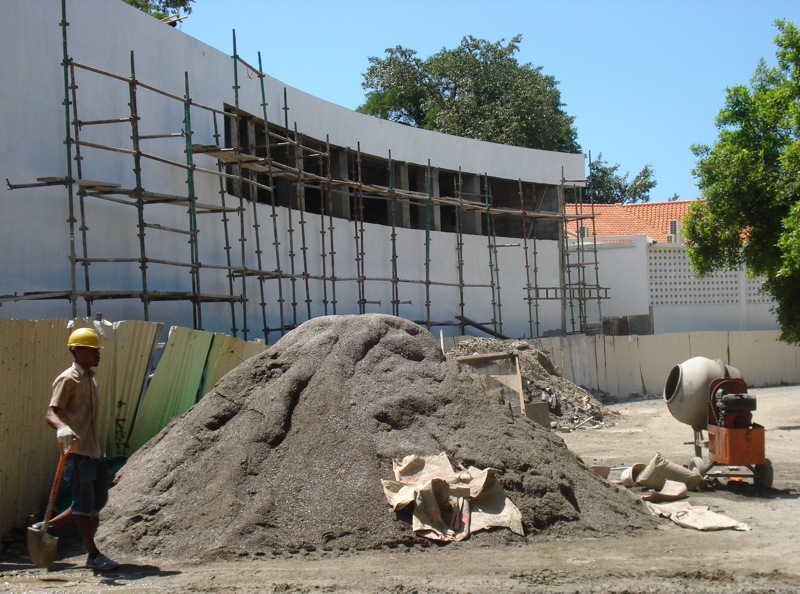
Audiovisual archive building under construction. Timorese Resistance Archive and Museum in background.

Audiovisual archive building under construction in Dili. The Timorese Resistance Archive and Museum in background.

Increasing national government investment in archives in Timor-Leste is clearly driving some of the more visible advances in archive developments in the country. Since my last visit in 2011, the splendid redevelopment of the Timorese Resistance Archive and Museum (AMRT) has been completed and construction of an adjacent purpose-built audio-visual archive building is well under way.

Somewhat less visible in Dili are the important archives of Timor-Leste’s Commission for Reception, Truth & Reconciliation (CAVR) and the Arquivo Nacional which holds administration records from the Portuguese, Indonesian and independence eras.

Ten days in Dili is not sufficient time to develop an in-depth understanding of each of these institutions. But my impressions are offered here as an indicator of the direction and progress being made in this area in independent Timor-Leste.

Timorese Resistance Archive & Museum (AMRT)

Since its establishment in 2005, the AMRT has set the pace for archive developments in Timor. The Lisbon-based Fundacao Mario Soares (FMS) largely funded the original building, a large resistance documents digitisation project and online database. The Timor government-funded building redevelopment has turned the AMRT into a much-visited showcase of resistance history.
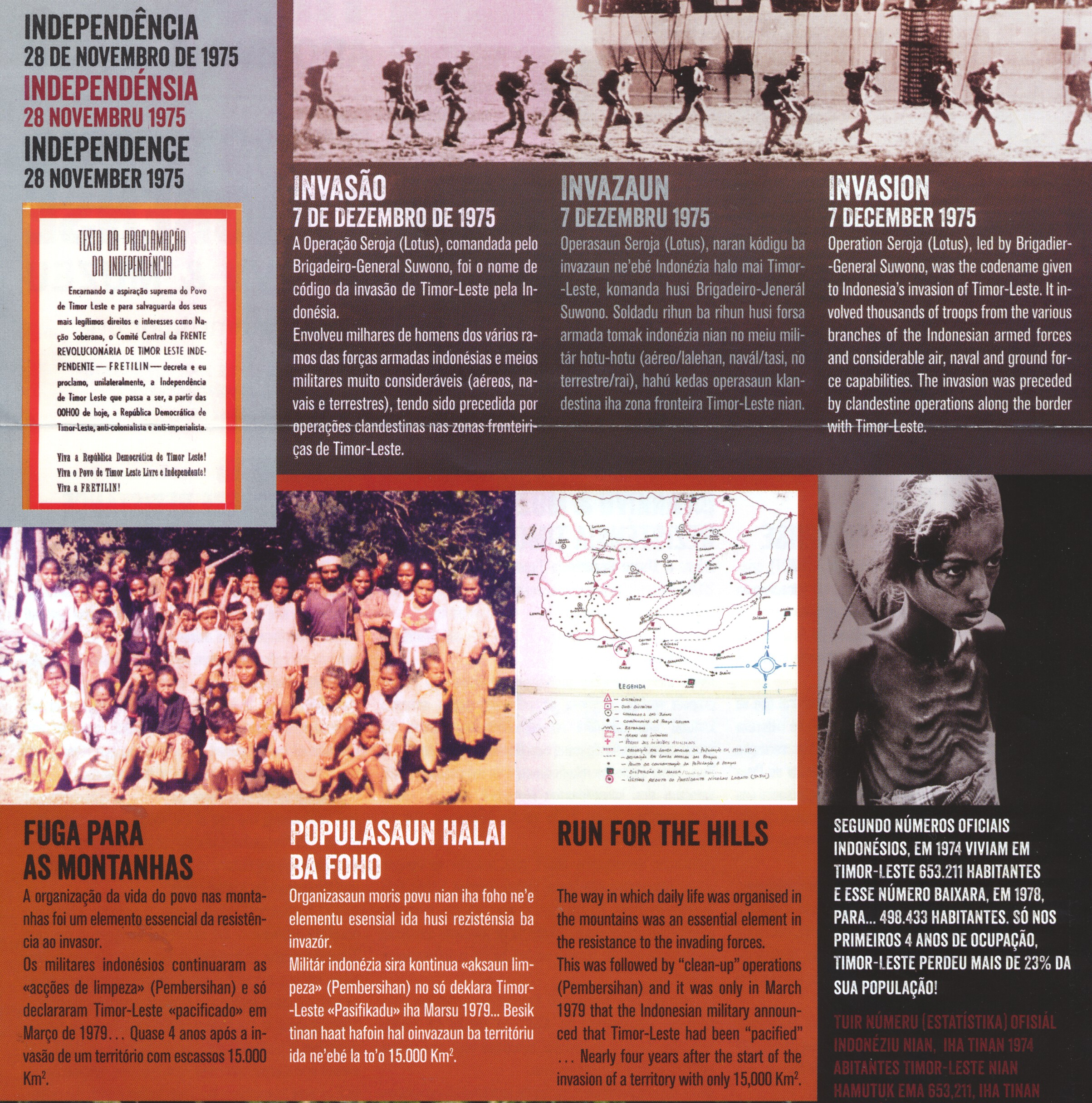
Fragments from the AMRT's permanent exhibition [Source: AMRT Brochure]

Fragments from the AMRT’s permanent exhibition [Source: AMRT Brochure]

In addition to an extensive multilingual permanent exhibition, the AMRT provides several workstations for researcher access to its digital document collection and a well-equipped auditorium for events and seminars.

Secure climate-controlled storage and processing areas are expected to facilitate the eventual return of resistance documents from Lisbon to Dili – an issue of considerable concern to some Timorese observers of archival developments. The AMRT is now actively soliciting for deposits of original materials from within Timor and outside.

The legal and administrative arrangements for the AMRT have progressed. In June 2014, Timor-Leste’s Council of Ministers approved a statute designating AMRT as a ‘Public Institution’, though I understand long-standing plans for a broad-based Timorese advisory board have stalled.

The AMRT, in common with all archival institutions in Timor, does not appear to yet have formally trained and qualified archivists among its staff. I believe there is a formal agreement mandating the FMS in Lisbon to continue its technical assistance and archival advice/training roles at AMRT.

 Arquivo Nacional

The Arquivo Nacional was the first formal archive to be established in newly-independent Timor-Leste, but it remains the least well-known. Few people seem to be aware of its existence or location.

Since its creation to preserve records of East Timor’s administrations, most of its effort has been devoted to arranging and describing the Portuguese-era records discovered in the attic of the Palacio do Governo after the 1999 independence ballot. This work has apparently been completed to a level allowing researcher access. However, there is not yet any publicly available guide to the archives contents.
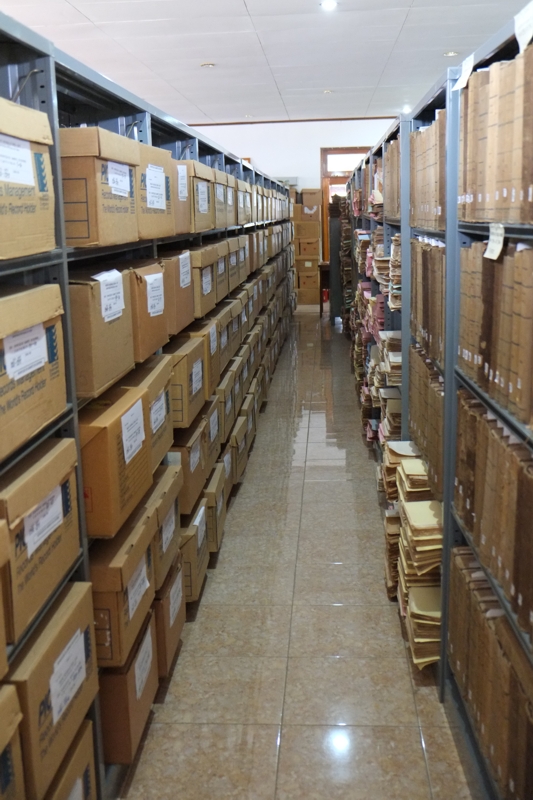
In the stacks: Portuguese colonial records at the Arquivo Nacional. [Source: C. Prata]

Portuguese colonial records at the Arquivo Nacional. [Source: C. Prata]

I was pleased to hear that work has now begun to examine the huge volume of Indonesian-era administration records being held in very poor conditions by the archive. A lack of suitable work space and storage areas is likely to continue to hamper this work. An even bigger problem lies in how to preserve the key records of the State of Timor-Leste since 2002. Many boxes of unsorted records from Ministries have been seen at the archive since 2009. Temporary storage in stairwells and passageways being testament to the problem.

Earlier cautious leadership and static budgets since 2003, along with the absence of any public advocacy for the archive’s development, have contributed to the archive’s low profile. Compared to earlier visits, however, my 2015 impressions suggest this is about to change. There is a spring in the step of staff I spoke to; an apparent renewed sense of purpose and direction.

This change of atmosphere may be due to recent international contacts and cooperation. Archivists from the National Archive of Brasil have visited Dili several times since 2011 and produced reports and recommendations for archival development. Arising out of this process came draft legislation which defines the structure and purpose of Timor’s national archive and is expected to be finalised by June 2015.

Another important development is Arquivo Nacional work to design record-keeping systems which will be promoted and applied in all government ministries. This will facilitate the transfer from government departments of designated long-term archival materials to the Arquivo. It will also, of course, help in the development of much-needed record-keeping systems in the government ministries.

Centro Audiovisual Max Stahl (CAMS)

Continuing serious illness has not stopped Max Stahl’s ambitions for the preservation of Timor-Leste’s cultural and political audiovisual heritage. If anything, it has intensified his drive.

Never content with just preserving his own historic game-changing footage of the 1991 Santa Cruz Massacre, Max Stahl has trained many Timorese in the art of recording interviews and cultural events in independent East Timor and then preserving and providing access to the materials.
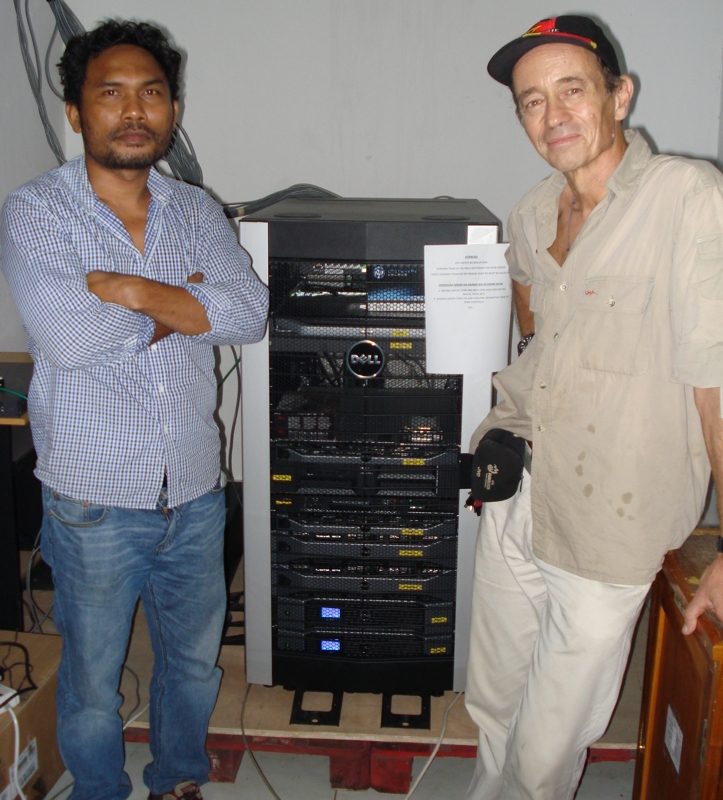
Max Stahl (r) and his technical assistant, Tony, with the new CAMS server equipment.

Max Stahl (r) and his technical assistant, Tony, with the new CAMS server equipment.

Since we last visited Max in 2011, there have been a number of ups and downs. In 2013, historic Stahl footage was inscribed on UNESCO’s Memory of the World register. However, CAMS had to move from its long-standing base in beach-side Farol and now occupies a less-salubrious unmarked building in the precinct of the national parliament, opposite the AMRT. Public controversy about the building owners’ opposition to the CAMS presence may yet require another move.

CAMS now receives significant financial support from the Timor-Leste government and has a more formal management structure than existed in earlier years. A formal relationship between CAMS and AMRT has been under construction for some time but there have been difficulties – the nature of which remain unclear and apparently unresolved.

The previously-established link between CAMS and the French national audiovisual institute, INA, continues to provide a secure, external archival storage facility. In Dili, CAMS has installed high-level computer server machinery and specialist audiovisual software to manage and provide online access to the digitised collection. Max envisages this latter development, combined with a move into the new building being constructed nearby, will pave the way for CAMS to become Timor-Leste’s national audiovisual archive.

CAVR Archives

The materials collected by Timor-Leste’s Commission for Reception, Truth & Reconciliation (CAVR) during its operation from 2002 to 2005 include a unique and irreplaceable record of personal experience of thousands of East Timorese during civil war and occupation (1975-1999). These archives are the responsibility of the Post-CAVR Secretariat which was established to protect the archive, promote the CAVR report, Chega!, and to prepare the ground for a successor organisation to continue these tasks.

The Post-CAVR Secretariat reports to the Office of the President; its funding comes from the President’s overall budget.
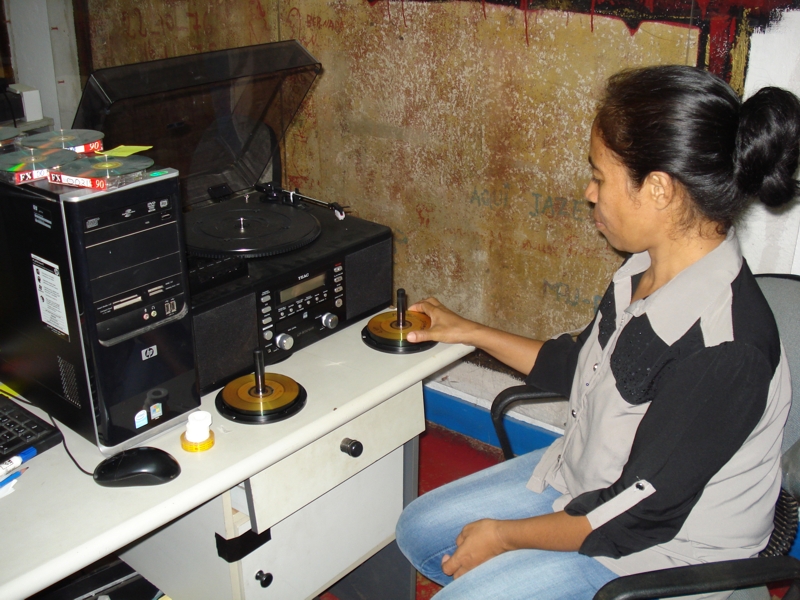
CAVR Archives staff digitising audiocassettes.

CAVR Archives staff digitising audiocassettes.

It is fair to say that since our visit in 2011, the Secretariat has been in a state of limbo. Legislative instruments for the establishment of a successor body (Institute of Memory) lapsed with the 2012 elections and there are few public signs that the matter has received urgent attention since. This uncertainty seems also to be reflected in the day-to-day work of the Secretariat, including the management of the archives.

There has over recent years been some disquiet from researchers about access to the archives. Unlike some overseas visitor experience, however, East Timorese researchers told me they had no trouble accessing the archives. On the other hand, these same researchers found that the lack of printed or electronic guides to the collection content made it difficult for staff to locate requested archival materials.

That said, there have been positive developments in archival preservation, including:

  • Post-CAVR has established some links with Indonesia’s National Archive and recently purchased from there a large quantity of archive boxes to replace less suitable containers currently being used. It is not clear whether increased links with the Indonesian archive are planned.
  • More significantly, archives staff have begun in-house digitisation of thousands of audio-cassette recordings of individual testimonies and interviews. While the processes being employed do not meet generally-recognised archival standards, they do significantly enhance the protection of these unique materials.
  • A substantial number of records of CAVR public hearings have been digitised and lodged with the British Library – as a means of external backup and to facilitate access internationally.

We hope the reported interest of both  the President and the new Prime Minister in establishing a CAVR follow-up institution will be acted on by the Parliament in the near future. And we hope such legislation will include clear statements on the need to preserve the archives following recognised standards, add to them and make them more easily accessible for research.

Acknowledgements

Special thanks to Margarida Mesquita and Cristina Prata for their invaluable assistance in Dili.

Many thanks to management and staff at each of the institutions for giving me the time to discuss their programs. Any opinions or errors of fact and interpretation are, of course, my responsibility alone. JW

———————————————————————–

Note: Other CHART notes on archives in Timor-Leste, including links to our 2003 and 2009 reports, can be found on this website’s Timorese Archives section.


Kevin Sherlock, 8 March 1934 – 2 October 2014

8 October 2014

All of us in the East Timor archives, history and research communities have lost one of our most treasured resource people. Kevin Sherlock devoted the second half of his life to finding, collecting and then selflessly and enthusiastically sharing knowledge, historic and current literature and archival materials about Timor.

We dedicate this page to his life, work and memory by providing information or links to items by or about Kevin. We start the ball rolling with a pointer to our 2011 article about Kevin. We will add material over coming days and invite readers to offer further information or reflections.

Kevin Sherlock at home in his own library/archive. June 2011

Kevin Sherlock at home in his own library/archive. June 2011

CHART Profile, June 2011

See this brief profile on Kevin Sherlock arising from a visit to his home in 2011. The piece includes a link to Kevin’s own account of how he began and conducted his Timor-life’s work.

Sherlock Collection

Kevin willed his extensive research collection of books and papers to the Charles Darwin University Library. Access to the collection must wait until it is arranged, described and catalogued by the Library.

Kevin’s incomplete 2002 shelf list of his provides a useful insight into the extent of his collection.

Some of Kevin’s extensive collection of books can now be seen in the CDU library catalogue. See here (sorted by earliest date first).

Digitised samples

We present here a few samples of Kevin’s work from his early Timor years. These samples come from the archives of Melbourne’s Timor Information Service (1975-84).

Bibliography,  January 1976
Probably one of Kevin’s earliest circulated lists of his emerging bibliography

Gazetteer,  April 1977
Self-constructed location guide to place names on widely known Portuguese Timor map

Letter to John Waddingham & Maurice Heading, 1977-10-07
List of published sources on Timorese anthropology

Timor study tour to Portugal, January 1981
Narrative account of research in Portugal, February-December 1980

Collection Acquisitions List, January 1981
Materials collected in Portugal during 1980 study tour

Letter to John Waddingham, 1982-11-07
Subjects: Senate Inquiry, land ownership & use, Indonesian publications

Collection Acquisitions List, January 1983
Covers period July-December 1982. Includes lists of Collection newsclippings, photographs, posters & covering letter to John Waddingham.

Tributes

Agio Pereira, Timor-Leste Minister of State: English / Portuguese

Jose Ramos-Horta [2014-10-08]

Tempo Semanal [2014-10-07]

ETAN Timor List [2014-10-7/10]

Sunday Territorian, Darwin [2014-10-19]


CHART FUNDRAISING EVENT: Melbourne, August 19

1 August 2014

sidney-flyer-header

A forthcoming public talk on post-election Indonesia by the internationally-recognised expert on contemporary Indonesian politics, Sidney Jones, will raise money for CHART’s East Timor archival work.

The event is organised by Peter McMullin and the Melbourne legal firm Cornwall Stodart in partnership with the Victorian Branch of the Australian Institute for International Affairs.

Sidney Jones
Sidney Jones is founder and director of the Jakarta-based Institute for Policy Analysis of Conflict. From 2002 to 2013, she was with the International Crisis Group’s Asia program, as Southeast Asia director and then as senior adviser. From 1977-2002, Sidney variously worked with the Ford Foundation, Amnesty International and Human Rights Watch. She is well known in Timor advocacy circles for her detailed research on human rights violations during the occupation.

Register to attend
Formal registration is required to attend this event.  Please register by close of business on Thursday August 14 through this online registration form.

Entry by donation to CHART
This event will assist CHART to raise much-needed funds for its ongoing Timor archives work. The organisers recommend a donation of $150 but if that is beyond (or below!) the means of some, other amounts are accepted. Donations to CHART are tax deductible.*

We look forward to your attendance and your support for our work.

John Waddingham
CHART Archivist & Manager

_______________________________________

*Please Note: Under tax deductible gift rules, the first $25 of your donation to attend this event will not be tax deductible.

Further information: event[at]timorarchives.info or phone 0421 179 533

Event leaflet


Authenticating Documents (3)

15 June 2014

Continuing our series of articles on the authenticity of rare materials from the early years of occupied East Timor, we briefly examine a 1980 resistance newsletter, ‘Nakroma’.

nakroma-1980-cover

Nakroma, 1980: Click image to read

Any document which might throw some light on the state of the Fretilin-led resistance after the military defeats of 1978-79 but before the historic 1981 reorganisation is of considerable interest. One such document which has recently come to CHART’s attention is a 31-page late-1980 newsletter  entitled Nakroma. Written in Portuguese-language over the name of Bere Malay Laka, the document reports and reflects on recent history and events and includes information on Fretilin.

CHART does not have the knowledge or resources to translate and fully analyse the document. We invite readers to examine the document (click image above) and offer comments on its content and whether there is any reason to doubt its authenticity.

Where does the document come from?

The 1980 Nakroma newsletter can be found in an Australian Department of Foreign Affairs & Trade (DFAT) file* held by the National Archives (NAA) in Canberra.

According to the file records, the document was passed to Australia’s Jakarta embassy sometime on or before 30 November 1981. Embassy staff reported that the item was given to them by ‘a church source’ with the information that it had been circulating in East Timor in hand-written form. No information is given on how this typescript version came into the hands of the un-named church source.

The DFAT file also records embassy staff talking with two different Catholic Church sources around this time – Father Zegwaard from the Indonesian Bishop’s Conference (MAWI) and the Vatican’s envoy to Jakarta, Monsignor Pablo Puente, an occasional visitor to East Timor. Both men were in regular contact with the Australian Embassy; either could have been the source.

Newsletter contents

The file shows that the DFAT head office in Canberra sent the document to its Lisbon Embassy for pointers to significant content, resulting in an English-language summary.

Of particular interest to CHART is the Lisbon Embassy’s translation of Nakroma‘s claims about military events during 1979-80 and a backgrounder on Fretilin. Especially notable in the latter is the naming of Fretilin as the Partido Marxista-Leninista “Fretilin”. 

Assuming the newsletter is authentic and was written in December 1980, this is the earliest public documentary reference to Fretilin’s formal adoption of Marxism-Leninism yet seen by CHART. It precedes the now well-known March 1981 reorganisation meeting records.

In addition to requests for comments made earlier, CHART also invites comments or corrections on the Lisbon Embassy’s translation and discussion on what this document adds to knowledge of the resistance before the March 1981 reorganisation.

——————————————–

NAA File Reference:  NAA 1838 3038-2-1 Part 21. See digitised copy.