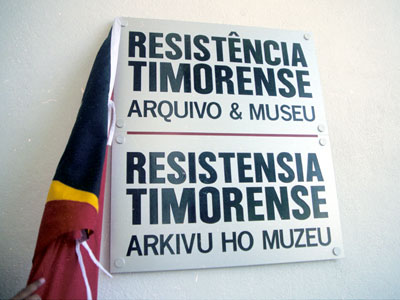
Resistance Archive & Museum: New database access

17 September 2010

The Arquivo & Museu da Resistencia (AMRT) in Dili continues to lead the way on access to digitised archives of the East Timorese struggle for independence.

In a new development, the online search facility has been re-designed to improve access to the well-established collection of digitised documents.

The centrepiece of the AMRT collection is internal resistance documents gathered from individuals throughout Timor-Leste since 2002.

Browsing document folders
Researchers now find documents by entering  simple search terms or navigating the collection’s database through browsing the underlying document folder structure. Previously, only visitors to the Archive in Dili could access the document folders on a dedicated stand-alone computer.
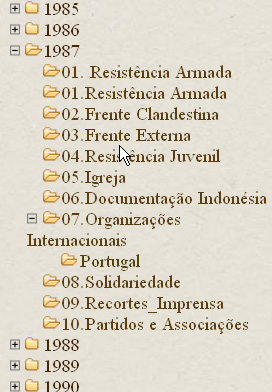
The predominant Timorese resistance document collections are arranged in folders by year; each year folder contains up to 10 standard sub-folders (see graphic).

The other main sections of the folder structure are Photographs and a Digital Library. The photographs folder contains a vast assemblage of images of the internal resistance and international solidarity campaigning. The digital library folder contains copies of published materials – from pamphlets to whole books. Many of these items come from the collection of Antonio Barbedo de Magalhães.

New document presentation
The onscreen presentation of documents has also changed. Instead of whole PDF documents being delivered from search results, documents are viewed page-by-page via navigation buttons. Database information about the origins and content of each document (metadata) is displayed alongside the page view. Page images can be enlarged for better readability.

Researchers’ gems
Some very useful items caught the eye of this researcher while browsing the folders. They include:
The guide to Jill Jolliffe’s well-known microfiche collection of Timor documents. (57 pages)
List of acronyms (9 pages)
List of resistance members’ names and pseudonyms (52 pages)

The latter two were probably internal AMRT documents developed during the course of building its database.

Comments
The new design of the search facility is a great improvement over the earlier version. I like browsing the folder structure and the new delivery method of search results – a summary of types of documents and their quantity – is welcome. While the facility is currently restricted to Portuguese language, this is no serious barrier to using the database.

On my wish list for a future improvements would be an advanced search screen which allowed searching for terms in a particular field of the database. At present a word is searched simultaneously across all database fields, sometimes producing too many results to easily browse. It does not seem possible, for example, to search for all items from a particular donor’s collection (Fundo).

Data accuracy & ‘crowd sourcing’
Large databases such as this inevitably contain typographical or informational errors. Having the data online provides the opportunity for end users to spot errors or offer valuable additional information to document data. Getting data help from end-users has the trendy title of ‘crowd sourcing’.

There are errors and holes in the AMRT database. Sadly, data corrections offered in the crowd-sourcing spirit by CHART in 2009 have yet to appear in the database. Perhaps when resources allow, the AMRT will consider establishing a formal method for end-users to submit data suggestions/corrections.

That said, the AMRT digitisation program, and making the material accessible online, is marvellous. AMRT is setting a fine example to all of us interested in making archival material accessible to present and future generations of Timorese and the international community.


Moment of truth for Timor’s truth commissions’ archives

19 July 2010

CAVR Archives: Priceless, unique, irreplaceable

Upcoming legislation in Timor-Leste’s parliament marks a critical moment in the long-term preservation of, and public access to, Timor’s truth commission archives.

Timor’s 2001-2005 Commission for Reception, Truth & Reconciliation (CAVR) and the 2005-2008 Indonesia-Timor joint Commission for Truth & Friendship (CTF) both hold archival records of long-term importance to the people of Timor-Leste, Indonesia and the broader international community.

Both commissions made broadly similar recommendations on the need for addressing justice and reparations issues arising from the violations of human rights they documented. Similarly, both commissions recommended the creation of formal entities to preserve and provide access to the respective commission archives and to collect, house and provide access to related materials currently held outside Timor-Leste.

Draft legislation

Draft legislation defining the institutional framework for implementing the recommendations of both commissions is now under active consideration by the relevant parliamentary committee. Committee A heard Timorese non-government organisations and victims groups’ comments on the draft legislation in early July. The Committee is expected to submit the legislation to Parliament for debate in September.

The Timorese NGO La’o Hamutuk is maintaining a valuable guide to this process, including background documents, links to the draft legislation text and some critical commentary on it.

Archival principles important

CHART’s brief submission on the draft legislation – limited to commentary and suggestions on specific archival aspects – can be found here.

The final form of the institutional arrangements to keep the commission archives is unclear. Regardless of the structure, some basic archival principles will need to be adopted. They include:

Collection integrity
Any legal action against perpetrators or reparations for victims must necessarily be based on evidence. If material collected by either commission can contribute to any such future actions, it is absolutely crucial that the evidence is protected against accidental, environmental or intentional/malicious loss, defacement or destruction.

For this reason, the legislation should enshrine the need to follow recognised international archival standards and practices for managing and protecting these important materials. Additionally, an offsite copy of the archives – similar to the post-CAVR secretariat’s initial projects with the British Library – should be mandated.

Collection authenticity
A piece of evidence is more likely to accepted if it can be authenticated as belonging to a body of evidence from a documented process or investigation. For this reason alone, it is important to keep records gathered by each commission as separate and distinct collections so there can be no confusion about the origins (gathering process, source) of the evidence.

For similar reasons, any related material collected later by the new institution should be maintained separately and not interfiled with either commission’s archive.

Collection Access
Public access to truth commission archives internationally is a complex issue. Restrictions on access to confidential victim statements from individuals may be necessary to protect the victim’s privacy or protect them against pressure or harm from alleged perpetrators. Allegations against individual perpetrators, yet to be tested in some legal process, may need to be protected to prevent private revenge actions.

These examples need to be balanced against the need for access to the records for reparation, legal, educational, historical research and memory reasons.

In the absence of post-independence laws in Timor-Leste on access to government documents and national archives, the current legisation should define rules on access – probably specifying that the post-CAVR secretariat’s  access guidelines be adopted as an interim measure.

Anecdotal evidence from researchers suggests already some difficulty in ease of access to CAVR archives, despite the existence of an access policy. Hopefully an ethos of public access – within prudent limits mentioned above – will be enshrined in the new institution, whatever form it might take.


Helen Hill’s ‘The Timor Story’ online

23 June 2010

Helen Hill’s influential 1976 booklet, The Timor Story, is now available online.

The Timor Story was written during the last months of 1975 and finalised and printed in the desperately tragic weeks after the December 1975 Indonesian invasion. It rapidly became the principal backgrounder and educational tool for the first generation of Timor activists in Australia and overseas.

The initial print run of one or two thousand was soon exhausted, leading to a cheaper format reprint of 5,000 copies.

Distribution and sales of the booklet were handled by the nominal publisher, Timor Information Service (TIS), which also funded the large April 1976 reprint.

While priced at a little above cost, the modest profits from sales allowed TIS to circulate copies internationally and build stock of other distributable Timor literature. This stock of resources was later handed over to Melbourne’s Australia-East Timor Association which, through John Sinnott, developed a highly effective Timor literature sales and distribution regime which continues to this day.

From memory, I  don’t think Helen was ever paid much, if any, royalty for this work. In a much more important way, however, the early activist networks owed much to Helen for her effort in writing this valuable booklet.

Note on digital copy

Scanning The Timor Story is part of pilot work by CHART to digitise a broader selection of important materials for online access.

The item scanned is from the first print run of The Timor Story. To keep file size down, the scan was done as black & white – so eliminating the original coloured cover shown above and reducing the quality of half-tone images.

This scan also includes a rough, uncorrected conversion of the page images to readable text, making at least some of the text searchable and accessible to ‘cut & paste’.

Your feedback on scan type and quality will be much appreciated.


Timor Information Service newsletter now online

22 June 2010

TIS special issue, February 1980

The newsletter of the Timor Information Service, Melbourne, is going online for long term international access.

Click here to access issues digitised to date. More to come.

TIS (as it was known) was one of the first formal newsletters in English serving the information needs of the Australian and international East Timor solidarity movement. Issue #1 was published 11 November 1975. The last issue (#40) was issued in March 1983.

Origins

TIS arose from informal gatherings of Melbourne activists connected to church and aid organisations. Created initially for educational use in Melbourne, TIS aimed to present a regular, credible account of the rapidly evolving situation inside Timor. While often drawing on the valuable and voluminous output of Sydney’s Campaign for Independent East Timor / Denis Freney, the TIS style was generally less polemical.

The first issues were put together by me (John Waddingham), Fr Maurie Heading from the Jesuits’ Asian Bureau Australia and Mary Considine from the joint Catholic-Protestant churches’ development education organisation Action for World Development (AWD). The name ‘Timor Information Service’ was suggested by Ian Bell who, with other Community Aid Abroad and International Development Action activists like Christine Carolan, also contributed to a $20 per week ‘stipend’ to allow me to work full time on developing the TIS.

TIS initially operated from spare office space at the Victorian Council of Churches in central Melbourne and from 1976 in a small attic rented from AWD when it re-located to inner-city Fitzroy. I continued to be the core (unpaid) TIS worker, aided by my partner Cecily Gilbert and a myriad of other volunteers who came and went over the years. TIS formally ceased to exist at the end of 1984.

Digitisation: Your comments sought

Scanning all issues of the TIS newsletter is a pilot project of a larger digitisation program planned by CHART. A random set of ten issues is available now. The remainder will be added in the next few weeks.

The scanning method chosen for this pilot is to scan the pages as images only. This means the text is not accessible for searching or cutting/pasting.  Your comments on these scans will be appreciated – especially on readability and the scan-as-image format.


Timorese access to published research

23 June 2009

The modest explosion of published research about historical and current Timor makes me wonder how much is readily accessible to the East Timorese themselves.

Alerts on discussion lists hosted by ETAN and the Timor-Leste Studies Association are valuable pointers to newly published articles, academic theses etc. Marvellous when links are provided for free access to the items,  but frustrating for many (not just Timorese!) when they see only an abstract from an inaccessible, maybe expensive, professional journal.

Timorese access to original archival primary materials held outside Timor is currently problematic. Access to published materials ought not be so difficult to organise.

Click to view paper

A recent paper on ‘free’ access to research findings partly addresses this question, outlining a number of strategies for students & researchers in developing countries to overcome access difficulties. Published by the London-based UNESCO-related Information and Communication Technologies for Development Collective, the paper focuses on resource-poor Africa but could also be relevant in Timor-Leste (click image at left to view).

Even better?

These strategies may be fine at an individual level, but it is not difficult to envisage an even better general solution. Imagine an institution like the National University or the planned National Library in Timor-Leste establishing a unit devoted to collecting all current published research for easy access inside Timor. I imagine most foreign researchers would be more than willing to offer copies of their work to such a collection.