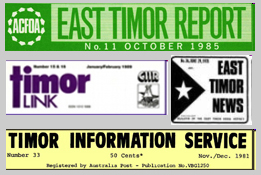
East Timor News 1977-1985: Now online

23 September 2010

Issues of East Timor News (ETN) are now available in digitised form through the Timor Archives: Newsletters website.

ETN was an Australian newsletter in the top rank of influential Timor solidarity newsletters in the early post-invasion years. In its first two years, it was the principal international vehicle for publicising, in English, radio communications from the Fretilin-led resistance inside Indonesian-occupied East Timor.

It began as a fortnightly publication in a newspaper format of ‘tabloid’ size. Like most comparable Timor newsletters of the time, publication became less frequent in later years.

After the loss of radio contact with the resistance in early December 1978, ETN continued production with analyses of available information and reproduction of significant reports, including mainstream print media articles.

Origins
ETN was produced in Sydney in the name of the East Timor News Agency (ETNA), 1977-1985. The driving force behind ETN was prominent Timor independence activist Denis Freney (1936-1995).

Denis Freney was a leading member of the Communist Party of Australia (CPA) at the time. He travelled to East Timor in 1974, soon after the formation of ASDT, the forerunner of Fretilin. He was the key figure in the Sydney branch of the solidarity organisation, Campaign for Independent East Timor (CIET), which had branches in most Australian states.

The Sydney CIET office was located in the old Boilermakers Hall in Castlereagh Street where, from 1975, Freney issued prodigious volumes of news and commentary on Timor using the roneo technology of the time. ETN began in 1977 as a more formal vehicle for Freney’s output; it was he who largely planned and prepared the newsletter. ETN was printed at the CPA printer at Forest Lodge and mailed out to subscribers by CIET volunteers.

Compiling the news input for ETN was a team effort – especially when it came to handling radio communications from the resistance. That work involved the clandestine radio team, transfers of tapes in Darwin and transcription in Sydney.  This team also transcribed Fretilin’s encoded communications and telexed them to the Fretilin External Delegation in Maputo, Mozambique.

Fretilin connection
Denis Freney worked very closely with Fretilin and was a confidant of senior members of the Fretilin external delegation in the early years.

From this distance, it is unclear whether the East Timor News Agency which published East Timor News is a direct successor to the ETNA created by Fretilin in East Timor in late 1975. The first issue of ETN in February 1977 is ambiguous on this question, but does talk of the ‘re-establishment’ of the 1975 ETNA.

Either way, Denis Freney’s strong, unambiguous commitment to Fretilin was reflected in the style and content of East Timor News. His identification with both the CPA and Fretilin meant that ETN, while widely valued in solidarity circles for its news content in particular, was often treated with scepticism by Australian mainstream media, many politicians and non-government organisations.

East Timor News has an important place in the archival record of Australian support for the East Timorese struggle for self-determination. We are delighted to make it available here.

Credits
Thanks to Cecily Gilbert for her work to convert the brittle and fading original newsletters into the digital form.

Thanks to Peter Murphy for some background information on ETN. Peter was a member of the original ETN editorial collective and currently coordinator/secretary of a CPA successor organisation, the Search Foundation.

Other sources:
A valuable record of the work of CIET and Denis Freney can be found in his surviving papers at the National Library of Australia (NLA). Library Reference: MS9535

The Freney papers at the NLA include a comprehensive set of his aforementioned roneo-format productions. In 2004 a copy of this set went to Timor’s Commission for Reception, Truth & Reconciliation (CAVR) in Dili. When resources permit, Timor Archives will digitise Freney roneod material surviving in the Timor Information Service archives in Melbourne.

Insider accounts of the clandestine radio team mentioned have been recorded by two participants, Brian Manning and Chris Elenor.


Digitising East Timor newsletters

17 September 2010

The CHART Project has established a new website to view copies of 1974-1999 East Timor newsletters.

Newsletters produced internationally by solidarity activists and non-government organisations, along with the Timorese external resistance and broader Timorese diaspora, were a key means of circulating information about East Timor. They were especially important and influential in the pre-internet days of the 1970s and 1980s.

Digitising for access

Timor Archives: Newsletters is designed as an interim access point for newsletters digitised in a larger scanning project by CHART.

The new website now holds a full set of Timor Information Service (TIS), 1975-1983. This word-searchable digital set of TIS supersedes the newsletter samples described on this Blog in June.

More to come

We hope to include as many newsletters as possible on the website – subject to the availability of original print copies and agreement from the original creators.

Newsletters currently in the scanning pipeline include the Denis Freney / ETNA  East Timor News newspaper, the Pat Walsh / ACFOA East Timor Report and Timor Link from the (British) Catholic Institute for International Relations (CIIR, now known as Progressio, has an active presence in Timor Leste today).

Still early days, but more to come.

If your organisation would like to include its newsletter in this collection, please email us: blog [at] timorarchives.info


Bob Hannan: Photographs 1975

29 July 2010

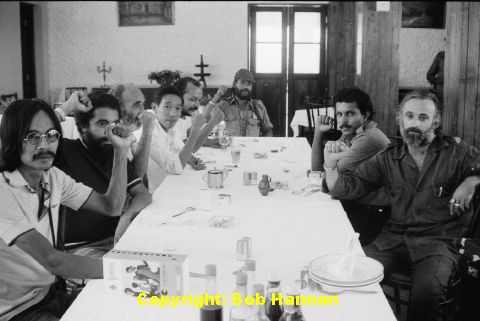
Before the horror. Bob Hannan's iconic image of a Fretilin gathering at the Turismo Hotel, September 1975

Australian professional photographer, Bob Hannan, made two visits to Portuguese East Timor after the short 1975 civil war.

Working for Murdoch press, he was among the contingent of media representatives which flew into Fretilin-controlled Dili for two days on 11 September 1975.

Taking leave without pay, Hannan returned to Timor later in September to capture more imagery of this dramatic period in Timor’s modern history.

The original (employer-owned) negatives of his first visit were reportedly discarded in a Darwin office clean out. Fortunately, the negatives from his later private trip survive in his hands.

Hannan has generously allowed CHART to digitise his negatives for archival purposes and to feature them here.

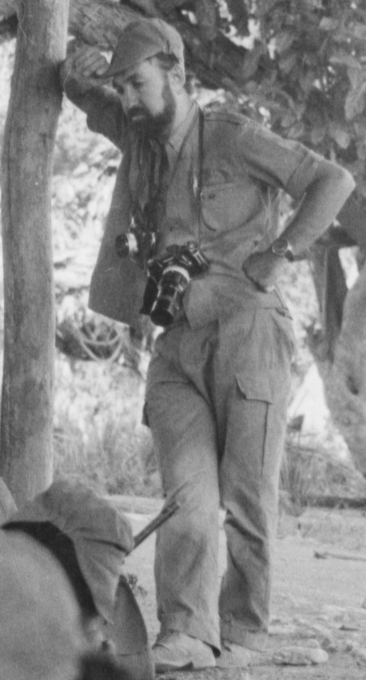
Bob Hannan after military skirmish at Batugade, September 1975

Atabae, Balibo, Batugade 1975

Bob Hannan’s ten rolls of black & white negative film include a few images from Dili, but are dominated by pictures of a journey to the troubled western border area.

In company with Australian Associated Press journalist, Rick Collins, and escorted by Fretilin soldiers, Hannan travelled to a major Falintil military base at Atabae. The contingent then travelled to Fretilin-held Balibo from where Hannan  (but not Collins) joined a Falintil patrol of Batugade where he recorded images from a skirmish with anti-Fretilin remnants.

Images from this journey were a feature of Jill Jolliffe’s 1978 book East Timor: Nationalism & Colonialism, but have not been widely seen since.

Identifying faces: Your help needed

Hannan’s photographs include memorable images of  personalities such as Fernando Carmo, Aquiles Soares, Rogerio Lobato and Cris Santos. Many other faces cannot be identified by Bob Hannan or CHART.

Please contact us if you can identify people or places in the images, or add information on the events pictured, so that data can be assigned to the images for future generations of East Timorese.

Comment directly on the online photographs (you have to sign up to Flickr), add a comment to this Blog post or email us at blog[at]timorarchives.info

Important notes

1. Bob Hannan reserves his rights for any reproduction of these images. Requests for use of any images should be directed through CHART (Email: chart[at]timorarchives.info).

2. Captions are yet to be added to the images. This will occur as time permits and your data on people and other content is received.

3. About half of the images in Hannan’s collection are featured on Flickr. A set of ‘proof sheets’ of all 200+ images is in preparation and will be published here at a later date.


Helen Hill’s ‘The Timor Story’ online

23 June 2010

Helen Hill’s influential 1976 booklet, The Timor Story, is now available online.

The Timor Story was written during the last months of 1975 and finalised and printed in the desperately tragic weeks after the December 1975 Indonesian invasion. It rapidly became the principal backgrounder and educational tool for the first generation of Timor activists in Australia and overseas.

The initial print run of one or two thousand was soon exhausted, leading to a cheaper format reprint of 5,000 copies.

Distribution and sales of the booklet were handled by the nominal publisher, Timor Information Service (TIS), which also funded the large April 1976 reprint.

While priced at a little above cost, the modest profits from sales allowed TIS to circulate copies internationally and build stock of other distributable Timor literature. This stock of resources was later handed over to Melbourne’s Australia-East Timor Association which, through John Sinnott, developed a highly effective Timor literature sales and distribution regime which continues to this day.

From memory, I  don’t think Helen was ever paid much, if any, royalty for this work. In a much more important way, however, the early activist networks owed much to Helen for her effort in writing this valuable booklet.

Note on digital copy

Scanning The Timor Story is part of pilot work by CHART to digitise a broader selection of important materials for online access.

The item scanned is from the first print run of The Timor Story. To keep file size down, the scan was done as black & white – so eliminating the original coloured cover shown above and reducing the quality of half-tone images.

This scan also includes a rough, uncorrected conversion of the page images to readable text, making at least some of the text searchable and accessible to ‘cut & paste’.

Your feedback on scan type and quality will be much appreciated.


Timor Information Service newsletter now online

22 June 2010

TIS special issue, February 1980

The newsletter of the Timor Information Service, Melbourne, is going online for long term international access.

Click here to access issues digitised to date. More to come.

TIS (as it was known) was one of the first formal newsletters in English serving the information needs of the Australian and international East Timor solidarity movement. Issue #1 was published 11 November 1975. The last issue (#40) was issued in March 1983.

Origins

TIS arose from informal gatherings of Melbourne activists connected to church and aid organisations. Created initially for educational use in Melbourne, TIS aimed to present a regular, credible account of the rapidly evolving situation inside Timor. While often drawing on the valuable and voluminous output of Sydney’s Campaign for Independent East Timor / Denis Freney, the TIS style was generally less polemical.

The first issues were put together by me (John Waddingham), Fr Maurie Heading from the Jesuits’ Asian Bureau Australia and Mary Considine from the joint Catholic-Protestant churches’ development education organisation Action for World Development (AWD). The name ‘Timor Information Service’ was suggested by Ian Bell who, with other Community Aid Abroad and International Development Action activists like Christine Carolan, also contributed to a $20 per week ‘stipend’ to allow me to work full time on developing the TIS.

TIS initially operated from spare office space at the Victorian Council of Churches in central Melbourne and from 1976 in a small attic rented from AWD when it re-located to inner-city Fitzroy. I continued to be the core (unpaid) TIS worker, aided by my partner Cecily Gilbert and a myriad of other volunteers who came and went over the years. TIS formally ceased to exist at the end of 1984.

Digitisation: Your comments sought

Scanning all issues of the TIS newsletter is a pilot project of a larger digitisation program planned by CHART. A random set of ten issues is available now. The remainder will be added in the next few weeks.

The scanning method chosen for this pilot is to scan the pages as images only. This means the text is not accessible for searching or cutting/pasting.  Your comments on these scans will be appreciated – especially on readability and the scan-as-image format.