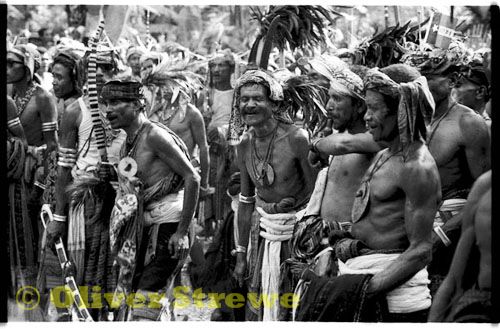
Oliver Strewe Photographs 1975

10 March 2010

In April-May 1975, young Australian photographer Oliver Strewe visited East Timor to photograph the land, its people and the optimism and excitement engendered by the impending end of Portuguese colonial rule.

Using Jose Ramos-Horta’s living room floor as a base in Dili, Oliver travelled widely in the countryside to take historic and memorable black and white images. Many of his pictures were used in the mid-1970s in East Timor solidarity publications worldwide.

A small sample of his images from that time can be viewed in CHART’s Oliver Strewe Album .

In these internet days, it is common to see Timor images circulated widely without knowledge of, or credit to, their origins or creator. That is certainly the case with Oliver Strewe’s images as well as those of other well-known pre-invasion professional photographers like Elaine Briere, Bob Hannan and Penny Tweedie.

These images will become much more valuable in the future if we can go back to their creators and learn something from them of the circumstances of their creation along with surviving data on where and when the pictures were taken in the first place.

The aim of this post is to begin to restore the connection between Timor images and their creators. I hope to do more of this over the coming months.

Note on images

The Oliver Strewe Album images are reproduced here with Oliver’s permission. The images are of restricted size – big enough to appreciate contents, but small enough to discourage unauthorised use.

All requests for access/use of higher resolution images should be directed to info@oliverstrewe.com or see Oliver’s website.


Songs from the mountains: 1983

13 January 2010

A 1983 audio-cassette of songs from the resistance has emerged from the shadows of an Australian private collection of Timor materials.

The 60 minute cassette contains resistance and traditional songs. The compilation is introduced by resistance leader Xanana Gusmao who also reads a soliloquy or poem in Portuguese.

How it came to be

The cassette was brought out of East Timor in 1983 by Senator Gordon McIntosh in whose archival collection a copy survives. McIntosh was in Timor as a member of the controversial Australian Parliamentary Delegation to the Indonesian-occupied territory in July that year. The music was given to him by one of the delegation’s Timorese transport drivers with a request that McIntosh post it to a Timorese in Australia (name forgotten).  On return to Australia, he posted the original but made and kept a copy just in case original disappeared.

Below are some samples from the copied tape. The quality is unsurprisingly variable – being the product of low-quality recording, tapes and copying facilities in the mountains.

[soundcloud url=”https://soundcloud.com/timorarchives/bushsongs-1983″ params=”auto_play=false&hide_related=true&show_comments=false&show_user=false&show_reposts=false&visual=true” width=”100%” height=”75″ iframe=”true” /]

Help needed

I have posted this sample to get help to answer some questions that come to mind.:

  • Is this compilation well-known and do copies exist elsewhere?
  • Are some of the non-traditional songs well-known now and were they composed after the invasion?
  • Were any of these songs more professionally recorded in the diaspora?
  • Is this compilation of particular significance to the record of resistance?
  • If significant, who/what is the best Timorese person/institution to assist to transcribe and preserve the compilation?

If you have answers to any of these questions I would be grateful for your comment on this blog (see ‘Leave a reply’ below) or an email to me at: blog[at]timorarchives.info

POSTSCRIPT [10:00 GMT]

A brief listening by a Portuguese speaker suggests that while songs dominate the recording, they may in fact be interludes to a long resistance message from Xanana to compatriots and supporters outside Timor.


Remembering 1979: Canberra & Jakarta public relations

2 January 2010

A 1979 submission to Australia’s Fraser Government Cabinet shows that politics, not East Timorese needs, was the principal reason for increasing humanitarian aid to East Timor in November that year.

The stated reason for ‘urgency’ in the submission:

Click to view

Recent publicity about the situation in Timor has led to criticism in Australia of the Indonesian Government and increasing public pressure on the (Australian) government to provide aid. We believe it is in the Government’s interests to respond to this problem as soon as possible.

No reference to the desperate humanitarian situation facing the Timorese at that time. The ‘recent publicity’ was Peter Rodgers’ articles and photographs of mass starvation in East Timor, highlighted earlier on this blog (see Remembering 1979).

The backgrounder attached to the formal submission makes fascinating reading for anyone interested in Australian government policy making on Timor at the time. It also provides an insight into Australian and Indonesian government views on Australian non-government aid organisations – including Indonesia’s alleged (inaccurate) branding of the Australian Council for Overseas Aid (ACFOA) as “actively pro-Fretilin”.

The backgrounder also shows the Australian Government knew there was a significant humanitarian crisis in November 1979. Researchers scrutinising the broader set of 1979 official documents now released for access should be able to learn just how early Australia did know about the desperate situation developing inside Timor during 1978/79.

Indonesian government propaganda booklet

Click to view

The cabinet submission background document also shows Indonesian Foreign Minister Mochtar didn’t care much for the picture revealed by Peter Rodgers’ articles. The articles certainly contradicted the Government of Indonesia’s own preferred international images of what life was like for the East Timorese in 1979.

The Indonesian Department of Information’s ‘To build a better tomorrow in East Timor’, printed on high quality paper in the second half of 1979, conveyed an image of modest but forward-looking progress for the East Timorese. Knowing what we know now about the truth of the situation inside Timor, let alone what most of us already knew in 1979, this Jakarta publication was a perfect example of why Indonesian Government claims about East Timor had to be treated with  maximum scepticism.

Note on sources

The Cabinet Submission is highlighted in this year’s release of the Fraser Government Cabinet records by the National Archives of Australia (NAA). Australian law requires the release of government records to the public thirty years after their creation – though this may soon be changed to twenty years (see earlier blog post).

NAA’s full selection of significant Foreign Affairs and Defence issues put to the 1979 Australian Cabinet can be found here.

The Indonesian Government publication is in the Timor Information Service archives, Melbourne


Nicolau Lobato

31 December 2009

Thirty one years ago today, Nicolau Lobato was killed in armed combat by Indonesian occupying military forces. For most East Timorese (and overseas supporters of Timorese self-determination) the death of this proud, authoritative Timorese nationalist leader was shocking news.
Lobato was a most potent symbol and personification of East Timorese resistance. His loss later turned out to be more than a symbol; it marked the virtual decimation of the original Timorese organised resistance. It took some time for the resistance to emerge from the defeats of 1978-79 – eventually under the new leadership of Xanana Gusmao.
Lobato’s loss also marked the height of despondency amongst East Timorese support circles in Australia and overseas – though solidarity organisations also managed to re-emerge two or three years later as a force to be reckoned with.
The re-vitalisation of Timorese resistance and international solidarity are big stories in their own right. What follows is a sample from my Timor Information Service archives on how we came to learn of Nicolau Lobato’s tragic death.

First reports & reactions
Australian Timor activists, from long experience, were highly sceptical of early Australian media reports of Lobato’s death. A report in the Brisbane Telegraph was typical with its vague references to Indonesian media, government or army sources:
The Telegraph (Brisbane) 02 January 1979

Sinar Harapan 02 January 1979

Indonesia media
Front page stories of Indonesian military action inside Timor were very rare in Jakarta media at anytime during the early years of occupation. This event was different. Pictures and stories of Indonesian military top-brass beside the alleged body of the slain leader were indications that the claims were true.

Sinar Harapan 02 January 1979

Merdeka 03 January 1979

Accepting the reports
I remember closely examining the Indonesian photographs of Lobato’s body in these reports and conceding that, despite obvious emaciation, it did seem to be the Fretilin leader.

Key Australian confidante of Fretilin and prominent activist Denis Freney sought our help to translate the Sinar Harapan article.  Our (unidentified) translator’s hand-written rough translation of the article survives in our files, along with a hastily typed version which was sent to Freney.

Translation of Sinar Harapan article

Denis Freney’s letter acknowledging receipt of the translation also concluded that the death of Nicolau Lobato looked to be true. His letter also pointed to the possible implications of his death for Australian and international solidarity work.

Freney letter to Waddingham 22 January 1979

……

A recent Fretilin short biography of Nicolau Lobato can be found here.


Remembering 1979

7 December 2009
alternate

Laga, October 1979 (Photo: Peter Rodgers)

Celebrations this year in Timor-Leste of the 1999 decisive ballot for independence reminded me of the terrible journey the East Timorese took to get to that historic moment.

The young girl pictured above is an icon of that journey. She personifies what became of hundreds of thousands  Timorese after just four years of Indonesian military occupation. By late 1979, somewhere between 100-200 thousand people were dead from killings and starvation, the Fretilin-led resistance was decimated and almost all the population came under direct Indonesian control for the first time since 7 December 1975.

Chega: Compulsory reading

The most definitive account to date of the evolution of this great disaster can be found in Chega, the report of Timor’s Commission for Reception Truth and Reconciliation (CAVR). Combining media and NGO research and reports of the time with personal testimonies of Timorese who endured and survived, Chega tells the story of a ruthless Indonesian military strategy, a dividing and failing resistance and the harrowing consequences for all Timorese. Chapter five of Chega – Forced Displacement and Famine – is compulsory reading.

Early sources

"The Age", 1 Nov. 1979

Journalist Peter Rogers’ reports and photographs from Laga in 1979 offered rare confirmation of what the Fretilin-led resistance had been reporting for years – that Timorese were being held in “concentration camps” and starved. Fretilin’s claims at the time were routinely rejected by governments and media as ‘unconfirmed’ or ‘exaggerated’.

Less easy to ignore was research material coming out of Australian NGOs – particularly from the humanitarian aid agency community’s peak body, the Australian Council for Overseas Aid (ACFOA). Months before Peter Rodgers’ reports, an ACFOA report – innocuously titled Aid and East Timor – had already concluded that a humanitarian disaster was occurring inside Timor.

Click to read

Aid and East Timor is historically significant for several reasons. It demonstrated that, with careful research, it was possible to learn what was happening inside East Timor despite it being closed to the outside world. The report proved to be the beginning of the re-establishment of the credibility and authority of ACFOA on East Timor issues in the following years.

While not credited in the report, it was largely written by one Patrick Walsh. The report was the first substantial product of Pat Walsh’s full-time focus on East Timor. In the following few years, his focus contributed dramatically to a higher standard of understanding, research and effectiveness in Timor solidarity and advocacy circles, both in Australia and internationally.