Herb Feith Foundation digitisation grant

25 September 2013

CHART is delighted to announce the receipt of a significant grant to digitise an important Timor archival collection.

The Herb Feith Foundation (HFF) grant of $24,400 will be used to begin an extensive digitisation of the Human Rights Office collection of the Australian Council for Overseas Aid (ACFOA, now ACFID). The collection, recording the work of Pat Walsh and associates from 1979-2000, is among the highest-ranking Timor archival collections still in private hands anywhere.

The most recent CHART guide to the collection contents can be found here.

Digitisation for Timor
The ultimate focus of the project is to make the digital copies available for East Timorese access through institutions in Timor Leste. The bulk of the grant will be used to train and pay assistants to conduct the scanning work. CHART hopes to engage, on a part-time basis, East Timorese students in Melbourne to do this work.

Smaller elements of the grant include equipment and software purchases as well as translation of key documents into Tetun and development of a Tetun-language version of the CHART website.

Herb Feith (second from right) with Jose Ramos-Horta and Australian Timor solidarity activists, c.1984. [Photo: Ian Bell]

Herb Feith (second from right) with Jose Ramos-Horta and Australian Timor solidarity activists, c.1984. [Photo: Ian Bell]

Herb Feith Foundation
Based at Monash University, the HFF was established in honour of the late Herb Feith (1930-2001). Herb was an internationally-recognised expert on Indonesia and one of very few Australian academics to work for justice for East Timor under Indonesian military occupation. More information on Herb’s life and work can be found here.

The Foundation funds a range of activities. A notable project with Timor parallels is the translation into English of Indonesian-language accounts of mass violence in Indonesia associated with General Suharto’s rise to power in 1965-66.


Andrew McNaughtan video archive: CHART work

25 July 2013

CHART’s Cecily Gilbert and John Waddingham recently spent two weeks in residence at the National Film and Sound Archive in Canberra examining the video collection of prominent 1990s Timor activist Dr Andrew McNaughtan (1954-2003).

Andrew McNaughtan with Jude Conway and FALINTIL commander, Taur Matan Ruak

East Timor 1999: Andrew McNaughtan with Jude Conway, FALINTIL commander Taur Matan Ruak, and camera. Credit: Jude Conway

The Andrew McNaughtan audiovisual collection holds some important historical footage from occupied East Timor in the 1990s. The collection was deposited at Australia’s National Film and Sound Archive (NFSA) in 2006, three years after Andrew’s sudden and premature death in December 2003.

Andrew McNaughtan visited Timor several times from 1994, always carrying a video camera. He travelled around the territory, recording countryside and village scenes and interviewing anyone who was prepared to speak to camera about life and conditions under Indonesian military occupation.

The collection is an important part of the surviving archival record of this significant Australian activist and the period he observed in East Timor.

Collection content
Andrew McNaughtan’s video for the 1994-1998 period contains rare material, some of which is probably unique. Raw footage of particular note for this period includes:

  • Extensive coverage of the 1998 university ‘Student Dialogues’ process
  • Smuggled Indonesian recordings of post-demonstration detentions and interrogations
  • Interviews with Church personnel, including priests, nuns and Monsignor Belo
  • Interviews with ordinary Timorese on military occupation, human rights violations, food production and shortages
  • Some marvellous scenes of countryside, jubilant pre-independence crowds, religious ceremonies and devotions

McNaughtan’s extensive record of the historic ‘Student Dialogues’ throughout East Timor in the second half of 1998 is especially interesting. He travelled with the student convoys from Dili to various centres across the territory, recording the public rallies and the obstructions they experienced from civilian and military officials.

Teamwork: NFSA’s Tim Cowie (left) and Tenille Hands (third from left) with John Waddingham and Cecily Gilbert.

CHART work
CHART’s two weeks at NFSA was devoted to viewing the McNaughtan material and recording data about the collection content for NFSA’s online catalogue.

The project provided a number of challenges – not least of which was trying to determine the date and location of some 100 different recordings. CHART’s final data set on the collection is far from perfect. Much work remains to be done to more accurately identify people, places, events and spoken content.

Our data on the collection will be available through this website when it becomes available on the NFSA catalogue in coming weeks.

Access to collection
The collection will be available for viewing at NFSA after it is catalogued.

CHART also nominated some sixty tapes for special digitisation by NFSA which will enable that footage to be viewed through NFSA offices or agencies in most Australian capitals.

NFSA has a longer term plan to make footage like this accessible online through its own website. NFSA also has adopted in recent years an in-principle commitment to ensuring key Timor archival materials are eventually accessible to East Timorese through Timor-Leste’s own archival institutions.

Further information on Andrew McNaughtan:
1. Document archives: CHART work and list.
2. Jude Conway’s photographic testimonial (on Clinton Fernandes website)
3. Collected reflections by friends and colleagues.


Australian diplomats: behind the scenes

18 July 2013

The National Archives of Australia (NAA) holds voluminous and content-rich records of the inner workings of successive national governments and their underlying bureaucracies. While there remain significant restrictions on access to NAA’s Timor-related holdings, there is still much detail to be learned from the open records.

CHART’s John Waddingham and Cecily Gilbert recently spent a day at NAA’s main reading room in Canberra. We present here a few snapshots of the day-to-day Timor work by officers of the Department of Foreign Affairs (DFAT) in the late 1970s.

A. Massive population displacement – 1978
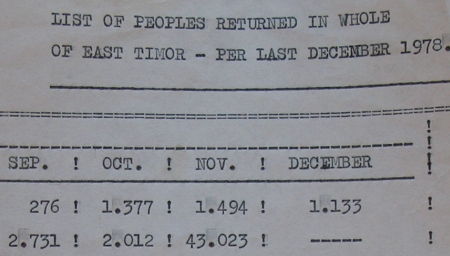
The 1978/1979 famine in East Timor was a direct result of major Indonesian military campaigns from late 1977 – especially as it resulted in huge numbers of East Timorese moving into camps under Indonesian control but without adequate humanitarian aid.

Click to see document

In early 1979 officers of the Australian Embassy in Jakarta received an Indonesian Red Cross document purporting to detail some 300,000 East Timorese ‘returning’ from the bush during 1978. This data was not made public at the time. It may now provide useful research data to help understand the scale of tragedy which unfolded.

—————-

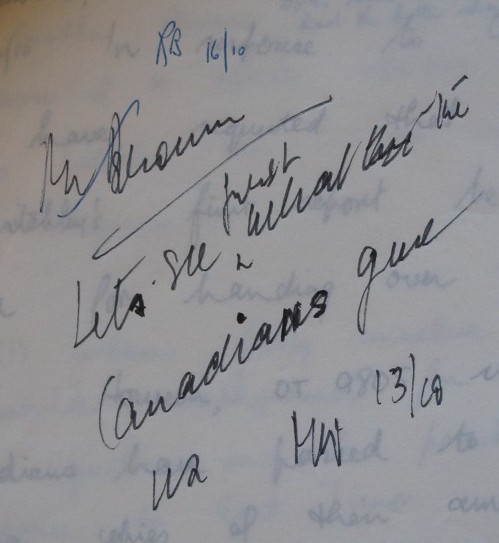
canada

‘Lets see first what the Canadians give us.’

B. Sharing information with allies
Ambassadors from several countries who visited East Timor in September 1978 saw the first signs of an emerging famine in the territory (see our earlier article). The archival record of what governments like Australia did and did not do to push for the much-needed entry of international emergency humanitarian aid is a key issue that CHART will explore further.

For now, however, a minor sideshow: Behind the scenes DFAT officers decide which of Australian ambassador Tom Critchley’s reports on his Timor visit are to be shared with Canada and New Zealand. The record shows the department ensuring it gets reciprocal information benefits from the sharing. Click image above to view.

—————-

jakarta-dunn-file-min

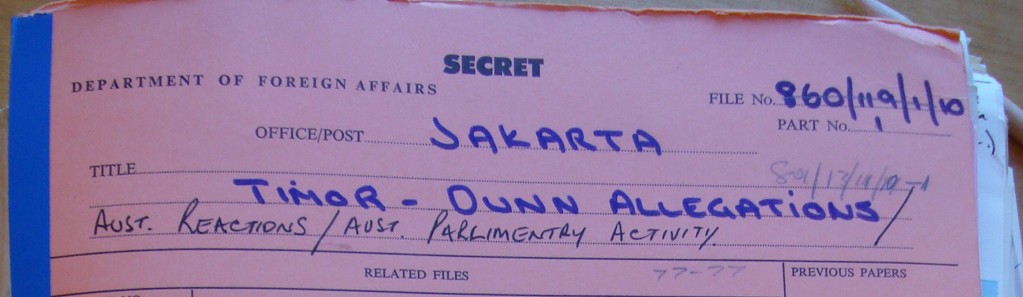
C. Jim Dunn and the Fraser Committee
NAA holds a packed lever-arch Jakarta Embassy file entitled “Dunn allegations”. While CHART had insufficient time to explore its full contents, the file clearly shows Jim Dunn’s contribution to the public debate was of great concern to the DFAT officers trying to manage the Timor issue.

Dunn’s March 1977 appearance before the US Congressional Sub-committee on International Organisations (known as the ‘Fraser Committee’ after its chairman, Donald Fraser) to report on human rights violations in occupied East Timor was a cause for much cable traffic between Canberra and Jakarta. The samples we show here are Ambassador Richard Woolcott’s reportage on conversations with the US Ambassador to Jakarta and a senior Indonesian Foreign Affairs official.

—————-

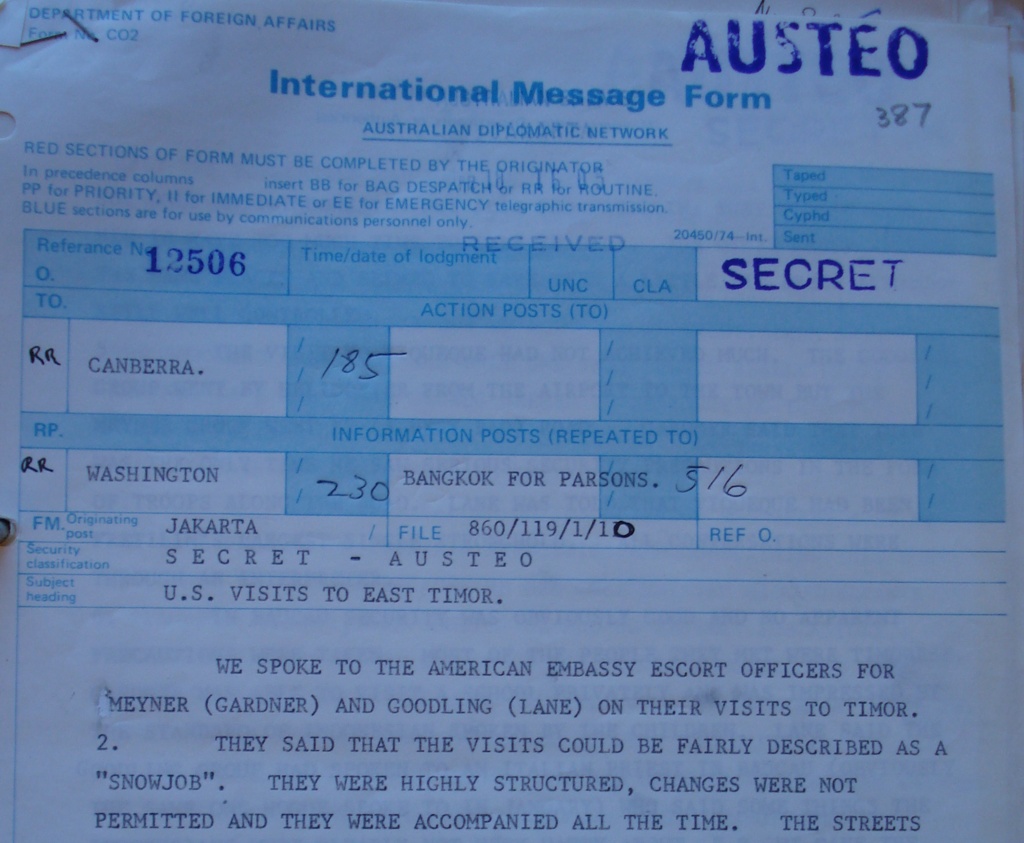
D. 1977 US Congressional visit – a “snow job”
Indonesian government alarm at Jim Dunn’s testimony before the Fraser Committee in March 1977 quickly led to a short, arranged visit to Timor by US representatives William Goodling and Helen Meyner. Media coverage of the April 1977 visit provided the headlines satisfactory to the Indonesian side (see example here); Meyner’s formal report and personal testimony to the same Congressional committee in July was somewhat more guarded.

The views and observations of the US embassy officers in Jakarta who accompanied Meyner and Goodling to Timor were communicated to the Australian embassy. The record of that conversation reports the US officers describing the visit as a “snow job”. The officers said they were telling more to the Australian embassy officers than they had communicated to Washington; they include reported claims against Jim Dunn and the Australian Council for Overseas Aid (ACFOA) – the latter accused of supplying military aid to Fretilin. Click image to read the conversation record.

And a curious sideshow to the July meeting of the Fraser Committee: It seems that off-the-record back room work was done by Australia’s Washington Embassy to delay the meeting. The reason was to ensure the meeting did not coincide with Australian Prime Minister Malcolm Fraser’s Washington visit in mid-1977. But why Ambassador Flood thought it necessary to avoid standard diplomatic cables to report this seems puzzling.

—————-

E. Keeping Fretilin / Ramos-Horta out of Australia
The Fraser Government decided in 1976 to no longer allow members of Fretilin’s external delegation to visit Australia. The ban was overturned by the Hawke Labor Government in 1983. Several attempts were made by Jose Ramos-Horta to enter Australia in those intervening years – without success.

We provide here a small window into DFAT consideration of such applications and the form of its recommendation to the Minister for Foreign Affairs, Andrew Peacock (who initials his agreement to deny Horta entry).

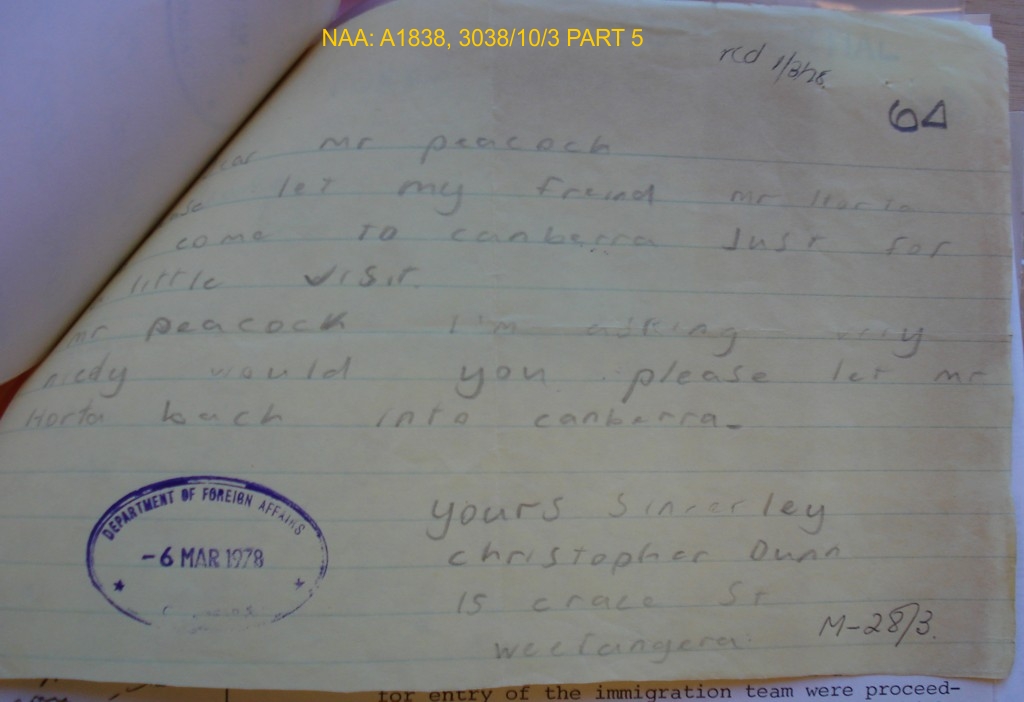
Christopher Dunn: Please, Mr Peacock....

Christopher Dunn: Please, Mr Peacock….

The file also contains a sweeter note: the original hand-written letter to Andrew Peacock by young Christopher Dunn (son of Jim) ‘asking very nicely’ for ‘my friend Mr Horta’ to be allowed to make a ‘little visit’.

—————-

National Archives of Australia References:

[A] NAA: A1838, 3038/10/11/2 PART 6. Portuguese Timor – Visits of Australians to Portuguese Timor

[B] NAA: A1838, 3038/10/11/2 PART 5. Portuguese Timor – Visits of Australians to Portuguese Timor

[C] NAA: A10463, 801/13/11/10 PART 1.  Jakarta – Timor – Dunn allegations – Australian reactions – Australian parliamentary activity

[D] NAA: A10463, 801/13/11/10 PART 2. Jakarta – Third country relations – East Timor – Dunn allegations

[E] NAA: A1838, 3038/10/3 PART 5. East Timor Fretelin [Fretilin] and pro Fretelin [Fretilin] activities in Australia


Bill Morrison Papers: Timor fragments

5 July 2013

CHART recently visited the National Library of Australia to examine some Timor fragments in the papers of former Australian diplomat and parliamentarian, the late Bill Morrison.

We present here a brief summary of the collection’s Timor-related contents and report our discovery of a minor archival treasure.

Bill Morrison. 1983

Bill Morrison. 1983 [Source: The Bulletin]

Bill Morrison (1928-2013) was a career diplomat-turned-politician who was a minister in the Whitlam Labor Government, 1972-75. He lost his seat in 1975 but returned to parliament in 1980 until becoming Australia’s ambassador to Indonesia, 1985-89.

While the Timor issue would have crossed his desk as Defence Minister in late 1975, his most prominent public connection to Timor was as leader of the controversial Australian parliamentary delegation visit to Indonesia in July-August 1983

Morrison collection
The National Library of Australia (NLA) holds Bill Morrison’s personal papers accumulated in his terms in public life (1969-1989). In many ways, the papers are typical of a number of other politicians’ archives in Australian public repositories. They contain a mixture of subject files, correspondence and files on specific parliamentary activities such as serving on various parliamentary committees. Morrison was a member of the Australian Labor Party (ALP) and his papers also include ALP internal organisational materials.

The National Library’s general description of the Morrison collection can be found here.

For a more detailed guide to the content of the collection, see the NLA’s online finding aid.

Access restrictions
The Morrison papers originally carried an undated 30-year restriction on access. Following CHART enquiries, the NLA manuscripts division has determined that some of the papers are available for immediate public access; others remain  restricted.

CHART learned in discussion with the NLA’s manuscripts curator that access to papers like Bill Morrison’s is subject to the 1983 Archives Act and the 1993 Parliamentary Services Act. In short this means, for example, that Morrison’s nearly-40-year-old Defence Minister files from 1975 still need to be examined by National Archives for possible exempt materials* before being cleared for access.

Similarly, the full extent of Mr Morrison’s papers on his time as Indonesian Ambassador will not be accessible until 2015; even then, the papers will likely be subject to prior examination by National Archives.

Bill Morrison's papers on the 1983 Parliamentary Delegation visit to Indonesia & East Timor.

Bill Morrison’s papers on the 1983 Parliamentary Delegation visit to Indonesia & East Timor.

Timor Content
CHART’s examination of a small selection of boxes from the Morrison papers revealed the collection to contain Timor materials of unquestionable research interest.

1. Labor Party Timor policy development
The collection contains materials offering insight into ALP policy development, especially on Timor. Of particular value are internal papers leading up the the landmark 1984 ALP national conference which watered down the party’s Timor previous position (see our earlier article on this issue).

2. Parliamentary Delegation
The three boxes of material on the 1983 Parliamentary Delegation, while partly restricted, offer particular insight into the original drafting of the delegation’s report. From the examined files, it seems that Morrison himself wrote in long-hand, the very first draft of key sections of the report. The boxes also contain a good collection of Indonesian print media coverage of the overall delegation visit and a comprehensive file on the so-called ‘chance meeting with Fretilin’ (see below), including the public controversy which followed.

Letter to Delegation, 1983

Letter to Delegation, 1983**

Buried treasure
The unscripted interception of a delegation vehicle by members of the Fretilin-led resistance became a public sensation; even moreso when it was alleged after the delegation’s departure that the Fretilin member’s words to Bill Morrison were mistranslated.

At the interception, the resistance member (Cancio de Sousa Gama) handed Morrison a letter from Fretilin – the text of which was translated and incorporated into the Delegation’s formal report.

CHART was greatly surprised to find the original letter in Bill Morrison’s personal papers at the National Library. Click image at right to see the front of the four-page original text.

CHART will explore the broader 1983 Parliamentary Delegation saga in more detail in coming weeks.

———

The Morrison collection at the National Library of Australia contains valuable additions to the overall archival record about East Timor, 1974-99. In addition to the non-Morrison primary source materials therein, it also offers some insight into Mr Morrison’s views and work on the East Timor issue which ran strongly against the case for East Timorese self-determination.

NOTES:

*Exempt materials: Materials which still contain sensitive information; see details here. In the case of East Timor, most government-sourced materials are automatically regarded as sensitive and a decision on access often takes many months.

** Fretilin Letter to Delegation, 26 July 1983, Papers of Bill Morrison, National Library of Australia, MS 4957 / Addition 1 November 1984 / Box 65.
[Letter reproduced here by kind permission of Pictures and Manuscripts, National Library of Australia]


CIDAC: Timor documents online

16 June 2013

CIDAC in Lisbon has digitised and made publicly available thousands of Timor archival documents.

We provide here a brief introduction to the collection contents and some preliminary observations on the search and access system of this marvellous addition to online archives about East Timor.

CIDAC's linking image to its online facility. Source: CIDAC

CIDAC’s linking image to its online archive. [Source: CIDAC]

Established in 1974, CIDAC (Centro de Intervenção para o Desenvolvimento Amílcar Cabral) in Portugal has been a long-time centre for activism and advocacy in support of East Timorese self-determination and independence. CIDAC holds the documentary records of two internationally known Portuguese solidarity organisations, CDPM (Comissao para os Direitos do Povo Maubere) and APPTL (A Paz é Possível em Timor-Leste).

CHART understands that CDPM, on ceasing its activities, committed to eventually housing its Timor documentary collection in a suitable repository in Timor-Leste. As an interim action, CIDAC has digitised some 10,000 items for universal access. According to the CIDAC website, the digitisation project was assisted with funding from the Fundação Calouste Gulbenkian.

Collection contents
Timor Online is a varied and rich collection of primary source documents and published materials – predominantly covering the years 1974-1999. It includes items written or created inside Timor before and during the occupation years as well as materials from the political Timorese diaspora and non-Timorese activists and non-government organisations world-wide.

One very valuable component of this digital library is comprehensive digital versions of some key activist newsletters from the occupation period. Titles include: Timor-Leste: Boletim de informação do CIDAC, Informações Timor-Leste & East Timor News – Monthly Memo (CDPM/APPTL), Funu (CDPM), Fitun (Estevão Cabral), East Timor News (CIET, Australia), Hadomi (Comunidade Timorense de Victoria), Informações (Gatimor / UDT),  Kaibauk (UDT) and Nakroma (DFSE).*

Searching and access
Access to all documents is governed by a conventional library-type search screen. Three methods of searching are possible – simple, basic and advanced. After several hours of exploring the collection, CHART recommends the advanced search screen for most searches.

'Advanced' search screen. Arrows indicate CHART-preferred settings.

‘Advanced’ search screen. Arrows indicate CHART-preferred settings.

Whatever the search term and method used, the search result is a list of items in the digital library, arranged in alphabetical order by author/creator of the item. The system searches for terms in the descriptions of the items only – Author, Title, Date (year) etc – it does not look for words in the documents themselves. Digitised documents are presented in the widely-used PDF file format.

Initial observations
Some experimental searches are required to get a feel for the collection’s contents and the data used to describe the documents. CHART recommends the ‘detailed’ record format (see red arrow in graphic) for search results because it provides the best picture of each document’s descriptive data as well as providing a direct link to the document (if digitised; most are).

Subject headings: Headings have been assigned to all items. This can be a useful way to find related materials, but requires some search ‘tricks’ to be fully successful. For example, entering the term ‘Cruz Vermelha’ (Red Cross) in the ‘Subject’ box of the search screen produces no results, but entering (exactly!) the term ‘Organizacoes Internacionais- -Cruz Vermelha’ produces 107 items by or about Red Cross.

Alternately, using the term ‘Cruz Vermelha’ as a ‘sentence’ in the simple search screen produces 111 records by or about Red Cross. The same term used in the ‘Author’ field of the advanced screen produces no results but using the terms ‘ICRC-CICR’ or ‘Comite international de la croix-rouge’ in the Author field produces 20 items created by International Red Cross. [See this search results list for these latter items.]

These problems are common to many search systems and can be confusing. One way to help the searcher overcome them is to provide a browse-able list of subject headings and authors to aid accurate and productive searching.

PDF files: The provided PDF files are photographic images of the original materials and do not contain searchable text. Another notable aspect of the files is that some are quite large. For example, Issue 67 of CIET’s East Timor News is over 37Mb in size. This item takes several minutes to download from the Portugal-based server. It would be possible to significantly reduce the file sizes to speed up access.

Congratulations to CIDAC
The preparation of such a digitised set of documents is a formidable task. The task of then providing access over the internet presents a set of different challenges which CIDAC has had to face and do the best possible with available resources.

CHART offers its congratulations to CIDAC for doing this work. Timor Online is a marvellous addition to the online documentary record of East Timor’s recent history.**

Notes:
* For a list of all newsletters in Timor Online, enter the letters PER in the Call number field of the Advanced search screen.

** The other major easily accessible online collection is available through the Timorese Resistance Archive and Museum.

Many thanks to Luis Pinto for drawing our attention to CIDAC’s Timor Online.